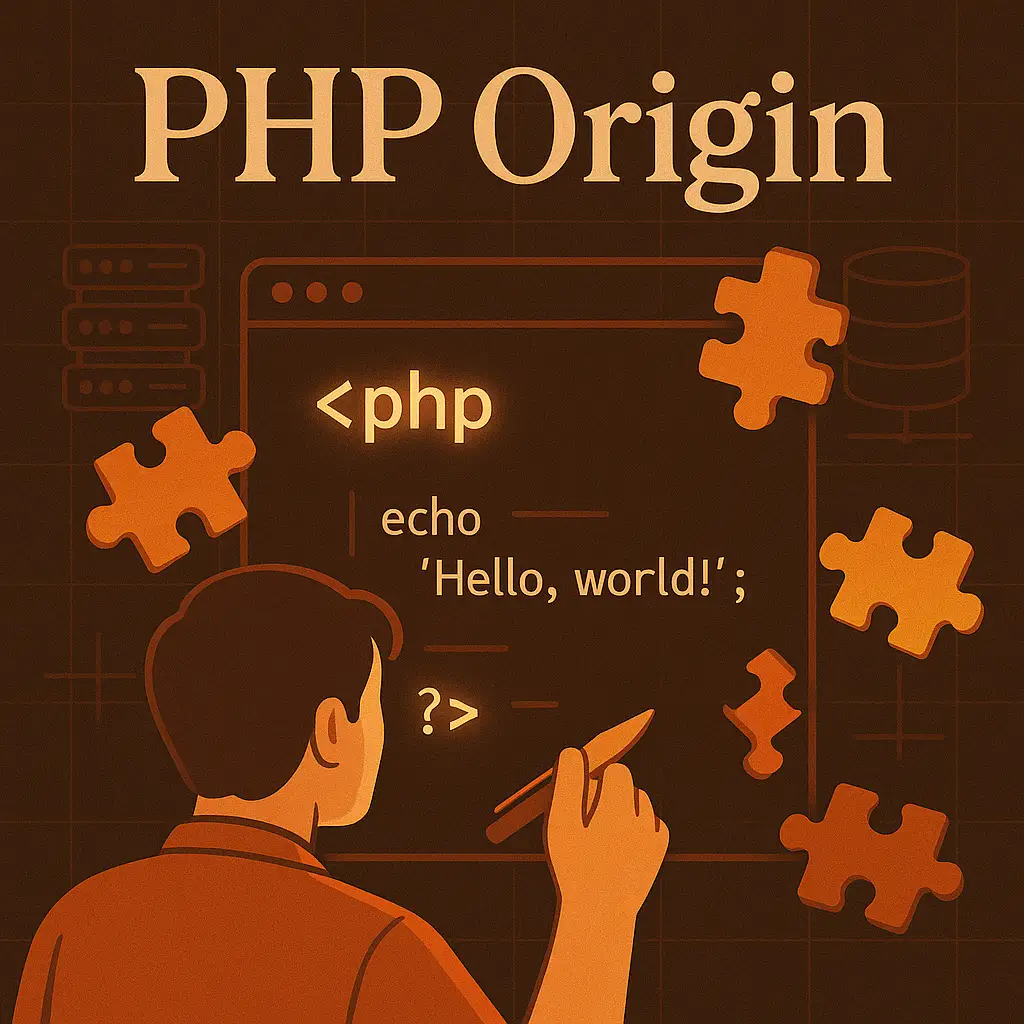
PHP has one of the more unusual origin stories in web development - it didn't start as a plan to build a programming language at all.
An Accidental Language
PHP began in 1994 when Rasmus Lerdorf wrote a set of small tools, called 'Personal Home Page Tools,' to help him track visitors to his own online resume. He open-sourced the code so others could use it, and other developers began extending it. By 1997, PHP 3 had been rewritten from scratch by Andi Gutmans and Zeev Suraski specifically as a general-purpose scripting language for the web, and PHP's name was reinterpreted as the recursive acronym 'PHP: Hypertext Preprocessor.'
Why PHP Spread So Quickly
PHP's early success came from a simple advantage: it was easy to embed directly into HTML, easy to deploy on cheap shared hosting, and had a low barrier to entry for beginners. This made it the language of choice for a huge wave of early web applications, and it's the language WordPress, Facebook (in its early years), and many other major platforms were originally built on.
From PHP 4 to Modern PHP
PHP 5 (2004) introduced a much more complete object-oriented programming model. PHP 7 (2015) was a major performance overhaul, roughly doubling execution speed in many benchmarks. Modern PHP (PHP 8.x) added features like union types, named arguments, and a JIT compiler - a far cry from the informal scripting tool it started as.
Why PHP Still Matters Today
PHP still powers a large share of the web, largely because of WordPress's dominance as a content management system. Frameworks like Laravel have also modernized how PHP is written, bringing clean architecture (MVC), a powerful ORM (Eloquent), and tooling that rivals frameworks in any other language. For anyone learning backend development, PHP remains one of the most practical, in-demand skills to have - especially in markets where WordPress and PHP-based systems are widely used by small and medium businesses.
Frequently Asked Questions
Is PHP outdated compared to Node.js or Python?
No - PHP is actively maintained and widely used in production. Each language has its strengths; PHP remains extremely strong for WordPress development, Laravel applications, and general web backends.
Should I learn plain PHP or go straight to Laravel?
Learning core PHP first is worth it - it helps you understand what a framework like Laravel is actually doing for you, rather than treating it as a black box.
Ready to Learn Web Development in Rajkot?
Book a free demo class and see Codeksha's classroom, project-based training for yourself.
Book a Free Demo Class