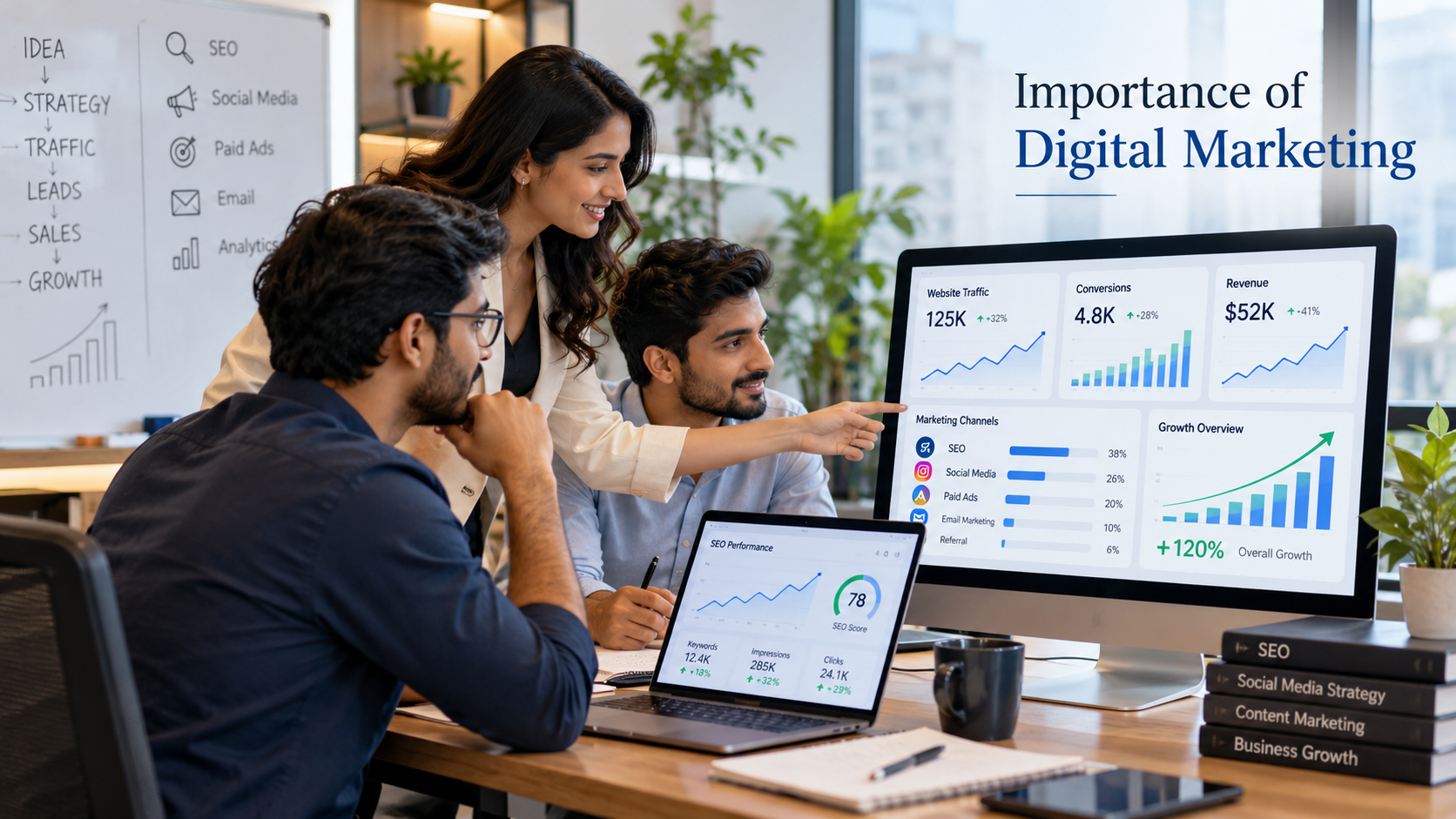
A good website is useful only when the right people can find it, understand it, and trust the business behind it. That is one reason the importance of digital marketing has become much bigger than simply posting on social media or running a few ads. Digital marketing connects a business with people while they are searching, comparing options, reading reviews, watching videos, and deciding what to buy.
From a developer's point of view, this becomes obvious very quickly. You can build a fast website with a clean design and working forms, but if nobody reaches the site, the technical work alone will not create business growth. The importance of digital marketing is that it brings together the website, search engines, content, advertising, analytics, and customer communication so each part supports the same goal.
This guide explains how digital marketing supports business growth, which channels matter most, where small businesses can benefit, and a few practical challenges that are easy to overlook.
Key Takeaways
- Digital marketing joins your website, search, content, ads, analytics and email around one business goal.
- The biggest benefits are relevant reach, measurable data, flexible budgets and steady lead generation.
- Small businesses can compete by focusing on specific services, locations and high-intent searches.
- Execution matters as much as strategy: tracking, consistency and patience with SEO decide the results.
What Does Digital Marketing Mean for a Growing Business?
Digital marketing is the use of online channels to attract, inform, convert, and retain customers. Common channels include SEO, content marketing, Google Ads, social media, email marketing, online reviews, and analytics.
The importance of digital marketing is not that every business needs to use every channel. The real value is being present in the places where your customers already spend time and making those channels work together.
A person may first discover a business on Google, visit its website, leave without buying, see the brand again on social media, and finally return through a branded search or email.
That journey is rarely as simple as one ad leading to one sale. Good digital marketing helps the business stay visible during several stages of the decision process.
Why Is the Importance of Digital Marketing So High Today?
Customer behavior has moved online. Before contacting a company, people often search for the service, compare multiple websites, check reviews, look at social profiles, and try to understand whether the business appears reliable.
This is where the importance of digital marketing becomes practical. It gives businesses a way to influence those moments instead of waiting for customers to find them by chance.
It also gives marketers far more feedback than most offline channels because clicks, enquiries, calls, form submissions, purchases, and other actions can be measured.
1It Helps Businesses Reach People Who Are Already Searching
One of the biggest benefits of digital marketing is search visibility. SEO allows a business to appear when someone searches for a product, service, question, or local solution related to what the company offers.
This matters because search traffic often starts with existing intent.
Someone searching for a web development course in Rajkot, for example, is showing a much clearer need than someone who simply sees a random advertisement.
The importance of digital marketing here is relevance. Instead of trying to reach everyone, businesses can create pages and content that answer specific searches and attract people who are more likely to care about the offer.
2It Builds Brand Awareness Before a Customer Is Ready to Buy
Not every visitor is ready to make a decision on the first visit.
People may discover a brand through a blog, Instagram post, YouTube video, search result, advertisement, or online recommendation.
Repeated useful exposure builds familiarity. A business that consistently publishes helpful content and maintains a professional online presence can become easier to remember when the customer is finally ready to act.
This is one of the advantages of digital marketing that can be difficult to measure with a single number. A click may not convert today, but it can still contribute to brand recall and trust later.
3It Makes Audience Targeting More Precise
Traditional advertising often reaches a broad group of people. Digital platforms allow much more specific targeting based on factors such as location, interests, search behavior, device, previous website activity, and in some cases demographic or professional signals.
For digital marketing for small business, this can be especially valuable.
A local business usually does not need to advertise to an entire country. It can focus its budget and content on the cities or service areas where customers can actually buy.
4It Gives Businesses Measurable Data
A website, search campaign, email, or advertisement creates data that can help a business make better decisions.
Teams can track:
- Website traffic
- Search visibility
- Click-through rate
- Leads
- Conversion rate
- Cost per lead
- Sales
- Engagement
This is one of the clearest benefits of digital marketing for business owners. Instead of asking only, “Did the campaign look good?”, the better question becomes, “Did it move the metric we wanted to improve?”
The importance of digital marketing is strongest when the business uses this data to improve the next decision rather than simply collecting reports.
5It Can Be More Flexible With Budget
Digital marketing is not automatically cheap.
Good content takes time, paid campaigns need testing, and strong SEO often requires technical work, research, and patience.
But digital channels usually give businesses more control over how money is allocated.
A campaign can be started with a smaller budget, tested, paused, adjusted, and scaled if it performs well. Organic channels such as SEO and content can continue bringing visibility after the original work is published, while paid channels such as Google Ads can provide faster exposure when needed.
That flexibility is one of the practical advantages of digital marketing for growing businesses.
6It Supports Lead Generation and Sales
Traffic alone is not the goal.
A business website should help visitors take the next useful step, whether that means calling, filling out a form, booking a consultation, requesting a quote, signing up, or making a purchase.
Digital marketing for business works best when acquisition and conversion are planned together.
SEO can attract visitors. Content can answer their questions. A landing page can explain the offer. Remarketing or email can bring interested users back.
The importance of digital marketing is that these activities can support one customer journey instead of operating as disconnected tasks.
7It Helps Small Businesses Compete More Effectively
Large brands may have larger budgets, but they do not automatically own every search result or every local customer.
A smaller business can still compete by focusing on specific services, locations, customer questions, and high-intent searches.
For example, a local training institute does not need to rank for every education keyword in India. It can build useful course pages, answer questions students in its city actually search, maintain accurate local information, and publish content around its real areas of expertise.
This is why digital marketing for small business can be effective even without enterprise-level budgets.
8It Improves Customer Relationships, Not Just Acquisition
Digital channels are also useful after someone becomes a customer.
Email, social media, useful articles, product updates, support content, and remarketing can help businesses stay connected.
The importance of digital marketing includes retention because repeat customers and referrals can be as valuable as new leads.
A business that keeps providing useful information after the sale can strengthen trust and create more opportunities for future business.
9It Connects SEO, Content, Paid Media, and the Website
One mistake is treating every digital channel as a separate activity.
In practice, the strongest results often come when the channels support each other.
SEO research can show what people are searching for. Those questions can become useful blog topics. A high-performing article can support a course or service page through internal links.
Paid advertising can send targeted visitors to a dedicated landing page. Analytics can show where visitors stop, which can lead to design or content improvements.
The role of digital marketing in business growth becomes clearer when all of these activities share the same commercial objective.
10It Helps Businesses Adapt as Search and Technology Change
Search behavior does not stay fixed.
AI-powered search, marketing automation, short-form video, conversational tools, and new advertising features continue to change how people discover information.
The importance of digital marketing also comes from adaptability.
Digital campaigns can be updated much faster than many traditional materials. Businesses can test new messages, improve pages, change targeting, and respond to real customer behavior.
The goal is not to chase every trend. It is to understand which changes affect your audience and adjust when there is a real reason to do so.
Which Digital Marketing Channels Matter Most?
There is no single channel that is best for every business. Each one does a different job:
- SEO captures ongoing search demand.
- Google Ads can create visibility quickly for searches with commercial intent.
- Social media helps with reach, community, and repeated brand exposure.
- Content marketing answers questions and builds topical authority.
- Email helps nurture people who already know the brand.
For most businesses, the better question is not “Which channel is best?”
It is: “Which channel matches the customer's current stage?”
A person who is actively searching for a service behaves differently from someone casually scrolling through social media.
Understanding that difference is part of building an effective digital marketing strategy.
The Part That Is Harder Than It Looks
This is the part that often gets missed when digital marketing is explained only in theory.
One practical difficulty developers and marketers run into is that tracking is rarely perfect on the first try.
A form may work correctly, but its conversion event may not be configured properly. A campaign may generate leads, but nobody may know which keyword or landing page generated the best-quality leads.
Analytics can also show a huge amount of data without automatically telling you what decision to make.
Another challenge is speed.
Paid advertising can start generating traffic quickly. SEO usually needs much more time. That can tempt a business to judge an organic strategy too early or continue spending on ads without improving the website receiving the traffic.
There is also the simple problem of consistency.
Publishing three articles in one week and then doing nothing for two months usually creates less value than maintaining a realistic process for useful content, page improvements, technical fixes, and measurement.
How Can a Business Start With Digital Marketing?
For businesses learning how digital marketing for business works, this order is usually easier than trying every available platform at once:
- Start with the business goal rather than the platform. Decide whether the priority is generating leads, increasing sales, driving store visits, receiving bookings, building awareness, or improving customer retention.
- Know the customer. Identify who the customer is and what they search for before making a decision.
- Make the website ready. Pages should load properly, explain the offer clearly, work well on mobile devices, and provide an obvious next step.
- Choose channels that fit the audience. Pick the ones that match where your customers actually make decisions.
- Measure a small set of useful metrics. Keep the reporting simple enough that it actually changes your next decision.
What Are the Benefits of Digital Marketing for Business Growth?
The main benefits of digital marketing include wider reach, more precise targeting, measurable performance, stronger brand awareness, better lead generation, flexible budgets, improved customer communication, and the ability to optimize campaigns using real data.
More importantly, these benefits can compound.
A useful page can gain search visibility, earn links, generate leads, strengthen the brand, and continue supporting the business long after publication.
That long-term effect is a major part of the importance of digital marketing for sustainable growth.
Frequently Asked Questions
Why is digital marketing important for business?
Digital marketing helps a business appear where customers research and compare options online.
It can support search visibility, lead generation, brand trust, customer communication, and measurable decision-making. This is why the importance of digital marketing goes beyond advertising alone.
Is digital marketing useful for small businesses?
Yes. Digital marketing for small business can be especially useful because targeting can be focused by location, service, audience, and search intent.
A smaller company can concentrate on a narrow market instead of competing everywhere at once.
What are the biggest advantages of digital marketing?
The biggest advantages of digital marketing are targeting, measurement, flexibility, scalability, and the ability to connect several channels around the same customer journey.
How does digital marketing help business growth?
Digital marketing helps businesses attract relevant audiences, convert more visitors into leads or customers, maintain relationships, and use performance data to improve future marketing decisions.
How quickly can digital marketing produce results?
It depends on the channel.
Paid advertising can generate visibility quickly, while SEO and content usually need more time to build rankings and authority.
A practical strategy often balances shorter-term acquisition with longer-term organic growth.
Final Thoughts
The importance of digital marketing comes down to one simple idea: businesses need to be visible, useful, and measurable in the places where customers make decisions.
SEO, content, paid advertising, social media, email, and analytics are not valuable just because they are digital tools. They become valuable when they help a business reach the right person, answer the right question, and create a clear next step.
Want to Learn Digital Marketing Hands-On?
Codeksha's Digital Marketing & SEO course in Rajkot teaches SEO, paid ads, social media and analytics through live, project-based classes. Book a free demo class and see a session for yourself.
Book a Free Demo Class